
About APORT
Long-term repair planning should be simple.
Reviewing a Long-term Repair Plan is a legal duty that returns every three years, and collecting the evidence takes a great deal of time. APORT shortens that work so that people on site can focus on judgment and decisions.
Company overview
| Company | APORT Inc. |
|---|---|
| CEO | Baul Seo |
| Founded | May 2026 (business registered June 1, 2026) |
| Business registration no. | 642-87-04102 |
| Location | 302, 8 Haengam-gil, Nam-gu, Jeonnam-Gwangju Integrated Special City, Republic of Korea |
| Business | SaaS for long-term repair plans based on public data and AI |
History
- 2024Defined the problems of apartment management sites and planned the business
- 2026.05APORT Inc. founded
- 2026.06SaaS development started, priority application for a business method patent, trademark application
- 2026.07Startup confirmation, copyright registration
- 2026.08Official launch of the APORT service (MVP built in three months)
- 2026.09Applied to and validated at operating complexes, applied for a public housing demonstration project
- 2026.10Completed market development consulting under the Startup-Centered University program; selected as an excellent company in a technology assessment by Korea Technology Credit Rating
Three things APORT believes
It should be simple
A statutory document should not become opaque because it depends on specialists and manual work.
We speak with evidence
Every amount is shown together with the number and range of public winning bid cases.
It is built for the field
We build intuitive screens that building managers can use without separate training.
Why long-term repair plans, and why now
The plan is a legal duty reviewed every three years, yet it is still a manual document whose evidence is hard to confirm.
- KRW 11.17 trillionLong-term repair reserves accumulated nationwide2026.6
- 3,299 casesReserve-related violations found in the last five years2021–25
Source: Ministry of Land, Infrastructure and Transport materials for the National Assembly audit (released by the office of Assembly member Cho In-cheol; Maeil Shinmun 2026.10.11, MTN 2026.10.7), Multi-Family Housing Management Act
A legal duty
Under Article 29 of the Multi-Family Housing Management Act, apartment complexes subject to mandatory management must establish a Long-term Repair Plan and review and adjust it every three years. Failure to do so can result in a fine of up to KRW 5 million (Article 102).
Four problems in the field
The basis of the costs is unclear
It is hard to confirm which cases and unit prices a construction cost was based on.
The work relies on manual effort and expertise
Checking the plan, identifying work items, reviewing cycles, comparing cases and estimating costs takes about 40 hours, or 7 to 15 days when outsourced.
Documents come in every form
There is a gap between complexes completed in the 1980s and the criteria introduced in 2014, and scans, photos and Excel files are mixed together.
There are gaps in oversight and verification
The LH maintenance information system for apartment housing closed on 2026.5.30, and the National Assembly has raised the need to manage the whole process from reserves to construction (2026.10).
The APORT service
After signing up, find your complex and upload the existing plan. You receive a report reviewed against the statutory criteria and actual construction cases.
Find your complex
Sign in with a social account and search by complex name or address. You can choose from
complexes connected to K-apt. Upload your plan
Drag and drop your existing Long-term Repair Plan as a PDF, Excel file or scan.
Receive the report
After payment you receive a PDF report of about 100 pages and a three-page summary.
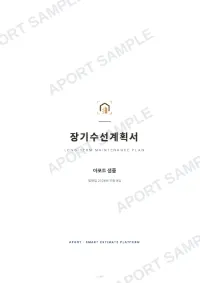
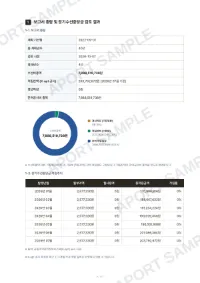
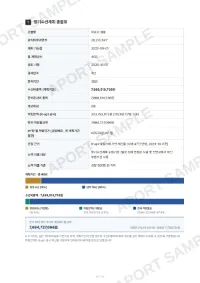 Sample report (Korean)
Three methods, depending on whether a plan exists
| Method | Suitable for | How it is calculated |
|---|---|---|
| APORT Standard | Complexes with an existing plan | Extracts facility information from the plan and reflects actual construction unit prices. |
| AI Analysis | Complexes without a plan | Analyzes appropriate prices from similar complexes and standard values. |
| Similar Complex | Complexes with a nearby complex of similar size | AI estimates from the average of similar complexes. |
If the service is hard to use
Just send us your management rules and the existing report. APORT will prepare it for you.
For collaboration or development partnership inquiries, please contact us at our company email. help@aport.kr
Core technology
Four modules for public data, OCR, the construction cost engine and report generation run on a three-layer verification system.
Data layer
- Synchronizes information on
complexes using K-apt complex codes. - Automatically selects comparable complexes by household count, completion year and region.
- Uses a complex code system compatible with government and local government systems.
- Synchronizes information on
Document parsing and work item standardization
- Converts scans, photos, PDF and Excel plans into structured data.
- Maps the different labels used by each complex to the statutory criteria of 7 categories and 69 items (as revised on 2026.7.30).
- Additional facilities can be supplemented by uploading an Excel file.
Construction cost engine
- Shows the number of K-apt public winning bid cases, their range and the position against the median as evidence.
- Warns that a check is needed when a value falls outside the range.
Report and reserve simulation
- Calculates the monthly reserve per household based on the formula in Article 31 of the Enforcement Decree.
- Includes comparison with similar complexes, reserve scenarios and construction opinions.
- Provides a three-page summary for reporting to the residents’ council.
Three-layer verification
Rule verification
Checks for omissions from the statutory 7 categories and 69 items (as revised on 2026.7.30) and checks repair cycles. Items that cannot be estimated are excluded from the total and marked.
Statistical verification
Automatically detects outliers against the range of K-apt actual transactions and the average of similar complexes.
Human verification
Users preview AI suggestions before applying them. Expert settings and revision history are supported.
AI does not replace judgment
Amounts and quantities are calculated from formulas and public data, and AI writes review opinions. Users decide whether to apply them, and every revision is preserved.
A service you can rely on
We collect only what is needed and operate on public data and verifiable evidence.
Minimal data collection
We collect only the name, email and password needed for operation, and use phone verification to prevent duplicate accounts. We do not make sales calls.
Based on public data
We use K-apt public data from the Ministry of Land, Infrastructure and Transport and published winning bid cases. We handle complex-level information and do not handle residents’ personal information.
Secure payment
Toss Payments supports bank transfer, virtual account and card payment, and we are enrolled in a purchase protection service. Quotations and invoices are issued immediately.
Revision history and restore
AI suggestions are applied after preview and revisions are logged. You can restore the original analysis at any time.
Certificates, registrations and intellectual property
| Category | Details | Date and status |
|---|---|---|
| SME confirmation | Confirmed as a small or medium enterprise | Issued 2026.6 |
| Startup confirmation | Confirmed as a startup | Issued 2026.7 |
| Mail-order business and publisher | Reported for online sales and report publishing | Completed 2026.6 and 2026.7 |
| Copyright | Service report (printed work) | Registered 2026.7 |
| Trademark | Service brand APORT | Filed 2026.6, registration in progress |
| Business method patent | Method for automatically converting administrative documents into a standard data structure | Priority application 2026.6 |
| Venture company certification | Venture company confirmation | In preparation for the second half of 2026 |
Applications and registrations are listed separately.
Customer support 24-hour AI manager, KakaoTalk, phone 1544-8321 (weekdays, Korean), training for building managers
Roadmap
- 2026
Official launch and initial demonstration
- 2027
More complexes, data standardization, property management company channel
- 2028
Predictive maintenance AI (aging risk analysis)
- 2029~
Data platform for local governments and public institutions
The roadmap reflects our current business direction and may change depending on development capacity and market response.
Partnership models
We work with property management companies and public institutions to set a new standard for long-term repair plans.

Property management companies
Standardize the three-year review of Long-term Repair Plans across many complexes, and prepare materials for residents’ councils at the same time.
Challenges in property management
- Reviews of plans for dozens to hundreds of complexes repeat every three years.
- Each complex writes its plan differently, creating risks of uneven quality and missing items.
- The basis of construction costs must be explained to residents’ councils.
What APORT provides
Batch processing and comparison across complexes
Organizes each complex’s plan under the same standard (7 categories and 69 items, as revised on 2026.7.30) and compares it with similar complexes.
Materials for residents’ councils
Provides winning bid evidence for each item, a three-page summary for reporting and a quotation.
Expert review
Repair rate adjustments, expert settings and history management reflect the judgment of the person in charge.
Printing and direct delivery
We have built a process with a partner to print report booklets and ship them directly to the complex.
How we work together
Pilot
Apply the service to some complexes on a trial basis.
Expansion
Extend to managed complexes after confirming the results.
Annual agreement
Agree on unit prices and the scope of support.
An integrated multi-complex management screen is planned for the first half of 2027. During the pilot, APORT staff help register complexes and generate reports.
Public institutions and local governments
We help complexes that struggle to establish plans, and help institutions understand the maintenance status of housing in their jurisdiction through data.
Background
The maintenance information system for apartment housing operated by LH closed on 2026.5.30, leaving a gap in support for complexes that struggle to establish plans. APORT aims to fill this gap with private-sector AI and public data technology.
Areas of cooperation
| Area | Details | Timing |
|---|---|---|
| Plan support for small and vulnerable complexes | Works with the Central Apartment Housing Management Support Center and local support centers to help generate and review reports for complexes that struggle to establish plans. | 2027 |
| Links with mandatory disclosure materials | Automatically uploads electronic documents standardized on K-apt complex codes to local government disclosure systems, with reference to the Seoul S-APT case. | After consultation |
| Analysis of the jurisdiction | Uses facility, repair history and construction cost data to analyze aging facilities for support and to help set maintenance budgets and project priorities. | 2028~ |
| Public housing demonstration | A demonstration project for LH and SH public housing is under application, and results will be shared. | 2026~ |
Public value
Reasonable management fees
Construction costs based on actual cases help keep residents’ management fee burden reasonable.
Digital accessibility
We aim for intuitive screens that older staff can use without training.
Transparent evidence
The basis of each calculation stays in the report, making audits and inspections easier to handle.
Data principles We focus on public data, use partner materials only within the agreed scope and purpose, and minimize personal information.
Partnership process
A four-step process from inquiry through a pilot and review of results to an agreement. This is a standard schedule proposal.
Inquiry and consultation
About 1–2 weeks
We confirm the purpose and target complexes and provide a sample diagnostic report and quotation.
Pilot
About 4–6 weeks
We register pilot complexes, generate reports and gather feedback from the field.
Review and agreement
After the pilot
We review time required, evidence secured, outlier warnings and satisfaction, and sign a memorandum of understanding.
Expansion and regular operation
During the agreement
We extend to more complexes and report results every quarter.
Areas of cooperation, roles and agreement terms are adjusted through consultation to suit each institution.
Interested in working with us?
Tell us about your organization and we will get back to you.